


Quantum Data Science Logo

Insights

Simple Analytics, Big Results: Act Fast on Customer Data for Growth

Simple customer analytics—like RFM segmentation and baseline models—can unlock revenue fast. Acting quickly and iterating beats chasing perfect accuracy, pragmatism, speed and regular model updates drive conversion, upsell and retention can drive long‑term growth.

Apr 02, 2026

Andrew Behrend headshot By Andrew Behrend
Two knowledge workers review a b test results. Quantum Data Science logo

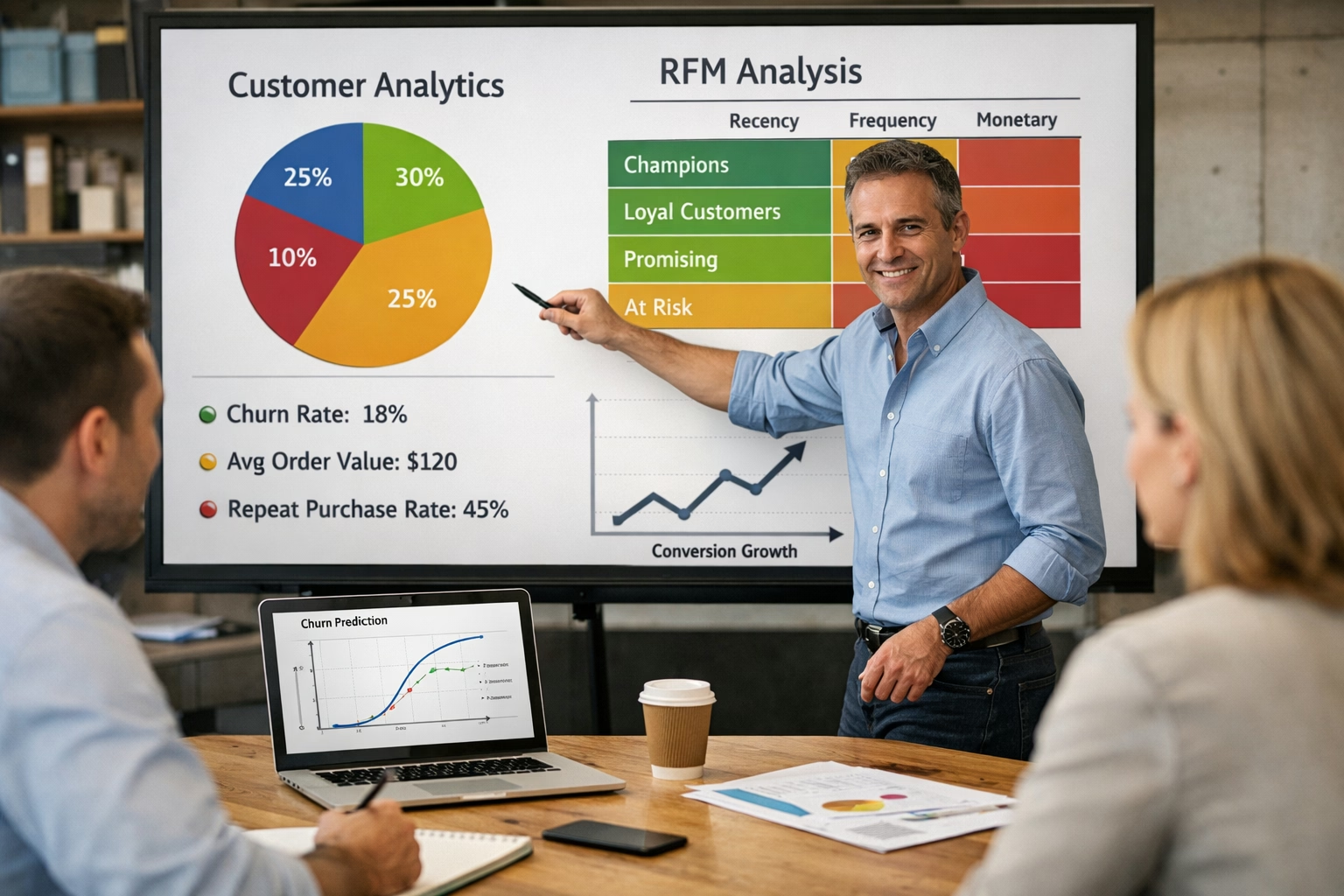
Organizations often assume that mining customer data requires sophisticated machine‑learning pipelines, mountains of variables and expensive tooling. In practice, many opportunities lie in plain sight. Simple behavioral variables: how recently someone bought, how often they transact and how much they spend can reveal who is worth engaging and what offers might resonate. This is the essence of recency, frequency and monetary value (RFM) analysis, a method that ranks customers on each of these dimensions to identify those most likely to buy again[1]. Because it relies on data every company already collects, RFM offers a pragmatic starting point for uncovering latent value. These measures may not capture every nuance, but they often reveal meaningful patterns that guide action.

Why Simplicity Often Wins (and When It Doesn’t)

Complex algorithms promise precision, but research shows that the returns to complexity are often limited. A study of supervised learning methods finds that many real‑world datasets have low intrinsic dimension; a small number of variables in a simple model do nearly as well at predicting outcomes as a large number of parameters in a complex model[2]. In applied forecasting, analysts note that when data are quarterly or annual, simpler models perform nearly as well as more complex ones and are easier to implement, maintain and explain[3]. Complexity may be justified for volatile, high‑frequency phenomena, such as real‑time fraud detection or dynamic pricing where more sophisticated algorithms can capture rapidly changing signals[3].

For many customer‑centric decisions, however, interpretable methods such as logistic regression or decision trees provide robust baselines. Practitioners in churn modeling, for example, often start with a baseline algorithm like logistic regression and use its performance to benchmark more complex approaches[4]. Starting simple allows teams to act quickly, measure impact and add complexity only when the incremental gains justify the cost.

Simplicity does have limits. RFM analysis may overlook high‑value customers who purchase infrequently or exhibit atypical patterns. Likewise, simple models may fail to capture interactions or nonlinearities that matter in certain contexts. Recognizing these limitations prevents complacency: simplicity should be a first step, not a final destination. The principle is to extract value early, learn from real outcomes and invest in complexity where it demonstrably improves decisions.

Avoid Analysis Paralysis: The Hidden Cost of Perfectionism

Perfectionism can become a trap. Analysis paralysis — the tendency to overthink and exhaustively evaluate alternatives — occurs when teams spend so much time weighing options that they fail to act. Psychologists note that overthinking driven by perfectionism, too many choices or fear of mistakes leads to indecision and cognitive fatigue[5]. This hesitation slows decision‑making, drains mental resources and reduces performance[5].

From a business perspective, delays translate into lost revenue and opportunity cost. A McKinsey survey of more than 1,200 executives found that while organizations often trade off between decision velocity and quality, faster decisions tend to be higher quality[6]. Companies that make good decisions quickly and execute them rapidly see higher growth rates and better returns than those that deliberate slowly[6]. In other words, speed does not merely coexist with quality it can enhance it by enabling more feedback cycles.

The value of iteration is also emphasized by practitioners. Kaggle grandmasters argue that the number of high‑quality experiments is the biggest lever in performance; the more you iterate, the more patterns you discover and the faster you catch failures, enabling rapid course correction[7]. A culture that values “learning by doing” builds momentum: each experiment produces data, informs the next decision and compounds learning. Spending months building a “perfect” model delays feedback and risks missing the moment.

Keep Pace with Change: Iterate Your Models

Markets and customer behavior are dynamic. Even the best model will degrade if it is not refreshed. Forecasters warn that no predictive model can withstand the test of time; regular updates must be built into the process[8]. Updates reflect new data, improved methods and changing contexts. The cadence of updates should match the business signal: a subscription churn model might be retrained monthly, while an annual segmentation of donors could be updated each year. Early warning systems for fraud or real‑time recommendation engines may require daily or even real‑time updates. Building iteration into the workflow ensures that simple models remain relevant and that the organization continues to learn.

Use RFM Segmentation for Quick Wins

How can teams operationalize these principles? A disciplined yet flexible approach helps move from insight to action:

1. Start with available data. Gather transactional and interaction data: purchase dates, order amounts, website visits, email opens. Compute basic metrics such as recency (days since last purchase), frequency (number of orders in a period) and monetary value (total spend). These simple measures can reveal significant patterns in customer behavior and provide actionable signals[1].

2. Segment thoughtfully. Rank customers on each metric (e.g., on a scale of 1–5) and group them into segments such as high‑recency/low‑frequency or high‑frequency/high‑value[1]. Use these segments to prioritize outreach. For instance, lapsed but historically high‑value customers may warrant re‑engagement offers, while loyal low‑spend customers might be candidates for cross‑sell campaigns. Keep in mind that RFM is a snapshot; it should be complemented with qualitative insights and other data when appropriate.

3. Build interpretable models. Apply logistic regression or decision trees to predict outcomes such as next purchase, upgrade likelihood or churn. Starting with a baseline algorithm provides a reference point; more complex models can be layered on if they deliver material improvements[4]. Validate the model using cross‑validation and compare it to a naive baseline. If performance is acceptable, move forward; if not, add features or explore alternative methods gradually.

4. Act and learn. Deploy campaigns based on model outputs. Send tailored offers to high‑value segments; remind lapsed customers of your brand; test different creative treatments. Measure incremental lift against control groups. For example, a software company might identify a cohort of customers with high frequency but low recent activity, send them a personalized upgrade offer and see a double‑digit increase in conversions compared with a generic campaign. Document what worked and what did not; feed that information into the next iteration.

5. Refresh regularly. Schedule periodic reviews — monthly, quarterly or aligned with campaign cycles — to refresh the data, retrain the model and adjust segmentation. Monitor for performance drift. Introduce new variables only when they add demonstrable value and when the added complexity is justified by the business context[3][8].

Balancing Speed and Complexity

The core trade‑off is between acting quickly on simple insights and waiting for marginally better models. Simplicity confers agility; it allows organizations to capture opportunities while they exist and to learn through experimentation. Complexity promises improved precision but requires more data, expertise and time. Evidence suggests that for many customer‑centric decisions, simple models capture most of the actionable signal[2].

Complex models are warranted when behavior is volatile, data are high‑frequency and stakes are high[3]. Recognizing when simplicity suffices — and being prepared to upgrade when it does not — is the essence of disciplined analytics. A pragmatic approach treats simplicity as a default, complexity as an investment and iteration as a constant.

Adopting a minimalist approach to data and models does not mean settling for mediocrity; it means prioritizing time to learning. By extracting value from simple data with simple methods, organizations can build momentum, generate immediate returns and foster a culture of continuous improvement. The perfect model can wait.

Footnotes

1. Investopedia – “Understanding RFM: Recency, Frequency, and Monetary Value in Marketing.” This article explains that RFM analysis groups customers by how recently they purchased, how often they buy and how much they spend, ranking each customer on a 1–5 scale. These scores help identify a firm’s most valuable customers and predict which customers are likely to buy again. Available at: https://www.investopedia.com/terms/r/rfm-recency-frequency-monetary-value.asp

2. Morucci & Spirling (2024) – “Model Complexity for Supervised Learning: Why Simple Models Almost Always Work Best, And Why It Matters for Applied Research.” In this paper the authors show that real‑world tabular datasets often have low intrinsic dimension, meaning that a small number of variables in a simple model performs nearly as well as a complex model with many parameters. Returns to complexity are muted or even negative in many cases. PDF available at: https://arthurspirling.org/documents/MorucciSpirling_JustDoOLS.pdf

3. OECD – “Forecasters’ toolkit: Choosing the right model for the task: Migration Anticipation and Preparedness.” The report notes that for migration flows with quarterly or annual data, simple models perform nearly as well as more complex ones and are easier to implement, maintain and explain; however, complex methods may be justified for volatile, high‑frequency processes. Available at: https://www.oecd.org/en/publications/2026/03/migration-anticipation-and-preparedness_c7c13bc4/full-report/forecasters-toolkit-choosing-the-right-model-for-the-task_af4817f2.html

4. Beyond the Arc – “Improving B2B retention with churn prediction models – 3 key things to know.” The article explains that data scientists typically begin churn prediction projects with baseline algorithms such as logistic regression or decision trees, using their performance as a benchmark before exploring more complex methods. Available at: https://beyondthearc.com/blog/2021/data-analytics/improve-b2b-retention-churn-prediction-models

5. Atlassian – “Analysis Paralysis: Definition, Example, and Tips.” This piece describes how perfectionism, too many choices, and fear of mistakes can lead to analysis paralysis, slowing decision‑making and reducing performance. It argues that overthinking decisions drains mental resources and impedes swift action. Available at: https://www.atlassian.com/blog/productivity/analysis-paralysis

6. McKinsey & Company – “Decision making in the age of urgency.” A survey of more than 1,200 executives finds that faster decisions tend to be higher quality and that companies that make decisions quickly and execute them rapidly see higher growth rates and better financial returns than slower‑moving peers. Available at: https://www.mckinsey.com/capabilities/people-and-organizational-performance/our-insights/decision-making-in-the-age-of-urgency

7. NVIDIA Developer Blog – “The Kaggle Grandmasters Playbook: 7 Battle‑Tested Modeling Techniques for Tabular Data.” Kaggle grandmasters emphasize that the biggest lever in performance is the number of high‑quality experiments; more iteration uncovers patterns, catches failures early and enables rapid course correction. Available at: https://developer.nvidia.com/blog/the-kaggle-grandmasters-playbook-7-battle-tested-modeling-techniques-for-tabular-data/

8. OECD – “Forecasters’ toolkit: Choosing the right model for the task: Migration Anticipation and Preparedness.” The same report stresses that no predictive model, no matter how accurate, remains valid indefinitely; regular updates must be built into the workflow to keep models aligned with current realities. Available at: https://www.oecd.org/en/publications/2026/03/migration-anticipation-and-preparedness_c7c13bc4/full-report/forecasters-toolkit-choosing-the-right-model-for-the-task_af4817f2.html

Recommended

Want to talk through your analytics decisions?

Share a bit about your context and goals. We’ll follow up with the right point of contact.

Contact us

Legal

Contact

Socials